Old Glory
July 3, 2013 1 Comment

My dad always hung a flag on the front of whatever house we lived in, with a heavy metal holder fixed onto either brick or siding, and the flag attached to a sturdy wooden pole. I loved being near it on a windy day so I could hear it snap and rustle as it danced with each gust. Even without the wind I was drawn to its crisp beauty: the bright red and white stripes and the field of stars on a sharp blue background. Dad brought it in every night before the sun went down and he put it back up first thing in the morning when he went outside to get the morning paper and milk delivery. When it rained and Dad wasn’t home, Mom would run out and bring it into the garage. I thought it was because the colors would run and turn everything pink like that time Mom washed my sister’s red dress in with our towels and underwear. I didn’t know exactly what the flag stood for, or why it was treated with reverence, or what the colors, stripes and stars meant, but I did know, even as a little one, that my Dad told me he fought for it once, and that was why he saluted it like the soldiers I saw in the movies. I wondered how big that guy was that Dad beat up for the flag, but knowing what he did for it made me proud of it.
Then when I began going to school I was pleased to see that at the beginning of the school day all my fellow classmates and I stood beside our chairs, put a hand on our chest, and recited the Pledge of Allegiance. To this day, fifty years later, I can still recall those words and imagine myself in the middle of a class full of kids, looking at the flag hanging on a tall pole in the corner, hand over my heart and saying those words along with everyone else, teacher included: “I pledge allegiance to the flag of the United States of America, and to the Republic for which it stands, one nation under God, indivisible, with liberty and justice for all.” Every single time I said it I felt a swelling in my heart, and even though I didn’t understand much about it, I believed I was beginning to know how my Dad felt. During the course of school I learned all about the flag, how it began with only thirteen stars, and how Betsy Ross made one for George Washington with the stars in a circle. The basic design of the flag stayed the same except that new stars were sewed on it when a new state entered the union. A teacher told our class once that the white on the flag represented innocence and purity, red represented valor and courage, and blue represented justice and vigilance. The stars, while signifying the number of states in the union, also stood for a new constellation in the sky, a new nation that would last forever. The stripes reminded us of the original thirteen colonies that declared their independence from the tyranny of England. As a school child I began to gain insight on the powerful significance the flag had on us all.
I remember seeing the funeral procession of President Kennedy on our television and cried when I saw the flag draped on his coffin, and when his little boy saluted the flag like a soldier. We all cried that day, even Dad. The image of a horse being led with boots backward in the stirrups still strike a deep chord with me today. I thought the President fought for his flag, too, and even though it looked like he had lost, he still got it.
My dad died when I was fifteen, just when I was beginning to learn from him and from school about the Second World War. He was in the Navy on a ship that went around hunting Japanese submarines. He told me the most beautiful thing he ever saw were depth charges going off in the night. I never got to hear all his stories, not only because he died, but because he said I was too young to know such things. But I learned plenty about it in my history classes, how it was for many a living hell, and I understood why he never told me some things. The image of those soldiers raising the flag at Iwo Jima struck a deep and resounding chord in me because I knew if my Dad had been there he would have helped, too, because he loved the flag so much. At fifteen and fatherless, I vowed to join the military to honor my father, my flag and my country. I joined Naval Junior ROTC in high school and immersed myself in military culture.
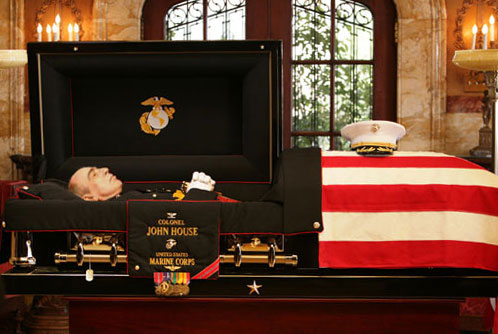
As soon as I graduated I went to the local recruiter and joined the Army. That began a nine year love affair with the military, and I matured quickly. I came to understand honor, discipline, respect, courage, responsibility, accountability and dedication for myself, my fellow brothers in arms, my chain of command, my family, my community, my nation and its leaders, and of course the stars and stripes. I volunteered every chance I got to be on flag duty, and without fail, I felt a lump in my throat and swell in my chest whenever I handled it. By then the flag represented freedom, it stood for liberty, it flew in honor of those patriots who fought and died for the United States of America, it was the face of my dad saluting it as the morning sun shined on his face, it was hung over the caskets of great men, it was everything good and right and noble.
One of the most incredible moments of my entire life was when I served in a funeral detail for a World War Two vet. I remember afternoon light filtering through the trees on a soft breeze, how incredibly quiet it was there in the cemetery even though there were dozens in attendance ringed around us solemnly. We lifted the flag from the burnished wood and folded it properly, keeping it taut as we went. My fellow soldier began to create a triangle with the flag and slowly walked it toward me as I held the end of it. With a firm but gentle tuck, I held it in my white gloved hands and very slowly and deliberately went to his grey-haired widow who sat beside the grave. I bent down, handed her the flag and looked into her grateful weepy eyes, and said “This flag is presented on behalf of a grateful nation and the United States Army as a token of appreciation for your loved one’s honorable and faithful service.” I then stood up and, very, very slowly gave the best salute I had ever given. Reader, I will remember that service with tears in my eyes for the rest of my life.
Now, whenever I see the flag, all that I have told you sweeps through me, not consciously, but in the very marrow of my being, and I always have the urge to stop and salute it. I will respect and guard the dignity of my country’s flag with all I have, and that is a bonafide promise. There are millions of others that feel just as I do, too, who are more than willing to fight and die for what that flag represents. Those who hate the United States, those who despise our freedom, those who want to destroy our country, they need to understand that as long as there is just one American standing, the stars and stripes will fly. They will never, never be able to destroy liberty, and they will never, never bring Old Glory down. It has been paid for with the blood of patriots and heroes and it is here to stay.

 jaytharding